
A creator business growth partner is the operator, strategist, and builder behind a creator-led company. They help turn audience trust into an owned business through better offers, products, customer acquisition systems, operations, and long-term growth infrastructure.

Creators are often told they need to post more, master another platform, or accept more brand deals. But more content does not automatically create a stronger business. A growth partner helps a creator move from being the sole engine of an audience to becoming the founder of a company with products, systems, customer relationships, and assets that can grow beyond daily posting.
What is the Growth Partner’s role
A creator business growth partner helps build the business behind the brand. Their role is not simply to increase followers or coordinate sponsorships. It is to identify where the creator has earned trust, find the most valuable audience problem to solve, and build a commercial model around that opportunity.
The work often includes:
Audience, market, and customer research
Positioning and offer design
Product strategy and validation
Pricing, packaging, and revenue-model decisions
Landing pages, email capture, and conversion systems
Launch planning and growth experiments
Sales operations and customer experience
Metrics, reporting, documentation, and process design
For example, a creator who regularly teaches founders how to win government contracts may have an engaged audience but no durable product infrastructure. A growth partner could help identify the strongest pain point, validate demand for a proposal-readiness program, develop the offer, build enrollment and delivery systems, and create a customer journey that does not rely on a daily stream of social posts.
A good growth partner is accountable to the business outcome: not vanity metrics, but customer value, revenue quality, retention, operational efficiency, and the creation of assets the creator owns.
What creators keep ownership of
A strong partnership should strengthen, not dilute, the creator’s control over what makes their brand valuable.
Creators typically retain ownership and final authority over:
Their name, likeness, voice, and personal brand
Their audience relationship and editorial point of view
Their original content and pre-existing intellectual property
Their social-media accounts, domains, and primary communication channels
Their reputation, values, and decisions about what they will promote
Their expertise, story, and unique creative direction
The creator is not a distribution channel. They are the source of credibility, trust, and insight that makes the business possible.
That does not mean every decision has to be made by the creator. In a well-designed company, the creator should remain close to the audience, brand, and high-consequence decisions while the growth partner handles much of the business-building work required to turn a promising idea into a repeatable operation.
Ownership should be documented clearly before a partnership begins. That includes intellectual property, product rights, brand assets, domain ownership, customer data, account access, payment processing, and what happens if the partnership ends.
What the growth partner owns
A growth partner may own defined deliverables, systems, or an agreed economic stake—but the exact arrangement should be negotiated and documented, never assumed.
Depending on the structure, a growth partner may contribute and maintain:
Research and business strategy
Product roadmaps and operating plans
Offer architecture, funnel strategy, and launch systems
Technology, workflows, and internal documentation
Sales, support, analytics, and reporting processes
Hired team members, contractors, or operational management
Capital, development resources, or execution capacity
In exchange, the growth partner may be paid through a project fee, monthly operating fee, revenue share, equity, or a hybrid model. The structure should match the real contribution and risk on both sides.
For instance, if a partner is delivering a defined landing page and email sequence, a project fee may make sense. If they are contributing substantial product development, launch execution, ongoing operations, and long-term risk, a revenue-share or equity component may be more appropriate.
The most important question is not, “What percentage does a growth partner take?” It is: What value, responsibility, risk, and ownership is each party bringing to the business?
Growth partner vs virtual assistant vs agency
A creator can work with multiple kinds of support. The right choice depends on the problem they are trying to solve.
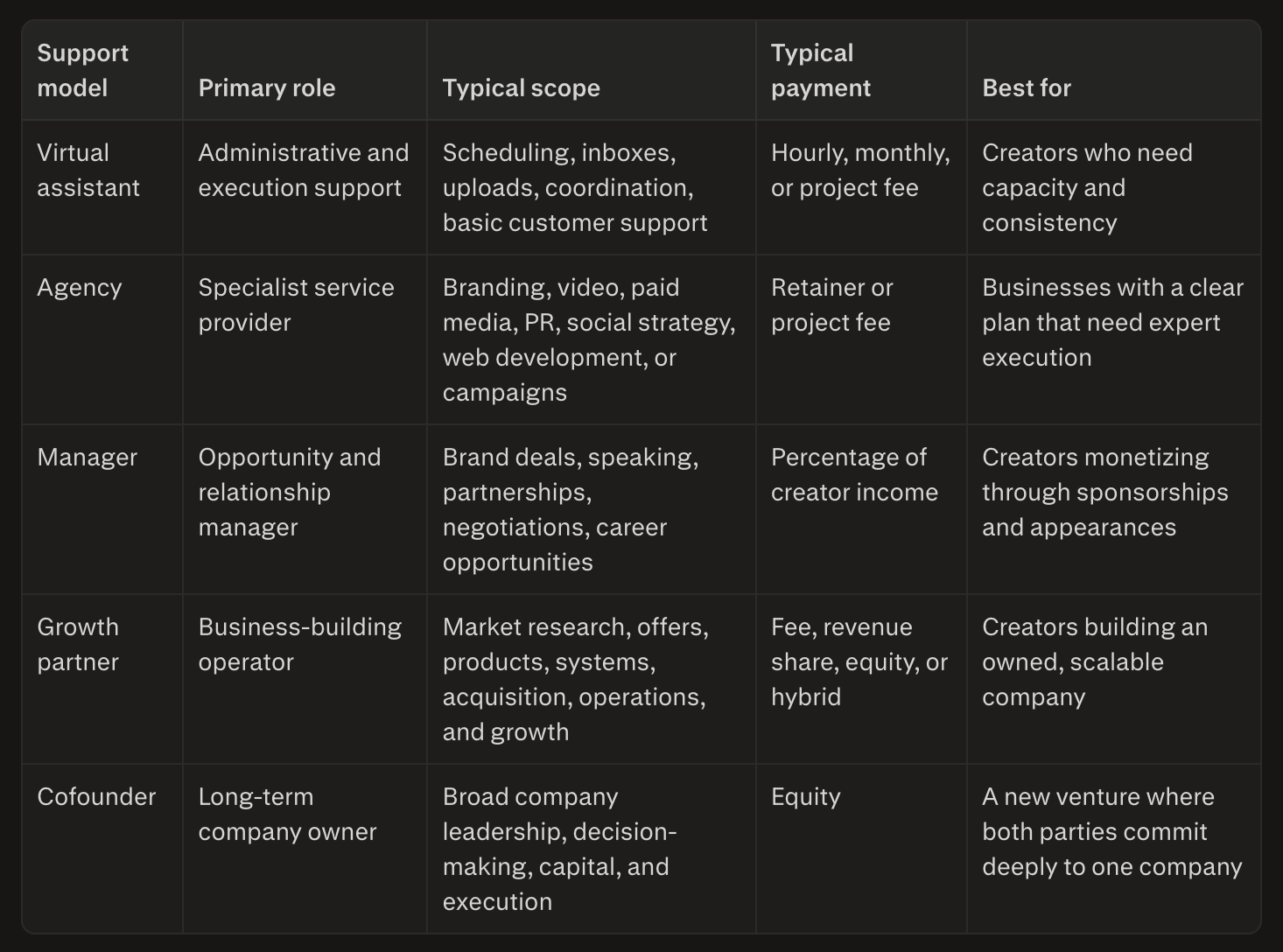
A virtual assistant helps the creator do more of what already works. An agency delivers a defined function. A growth partner helps determine what business should exist, then works to build the system that makes it viable.
None of these models is automatically better than the others. A creator with a validated offer may need a paid-media agency. A creator overwhelmed by logistics may need a virtual assistant. A creator with strong audience trust but no product, business model, or operating team may need a growth partner.
How a growth partner helps with the content treadmill
A content treadmill happens when a creator must constantly publish, perform, or chase platform reach to generate income. The work may be lucrative, but the business remains fragile if revenue disappears whenever content output slows down.
An asset-oriented creator business builds value that compounds over time:
An owned email list and direct customer relationship
A product or service that solves a repeatable problem
A recognizable brand with clear positioning
Customer testimonials, case studies, and referral loops
Documented sales, onboarding, and delivery processes
Data that improves product and marketing decisions
Intellectual property, technology, or curriculum
A team that can execute without the creator doing every task
The creator’s content remains important. It is often the trust engine and the top of the funnel. But content becomes more powerful when it leads into an owned business system rather than acting as the entire business.
For example, a fitness creator may begin with sponsorship revenue and one-to-one coaching. Over time, they might build a training methodology, a paid member community, recurring programs, certified coaches, and a software-supported customer experience. The creator remains central to the brand, but the company becomes less dependent on selling each hour or each post.
That is the difference between monetizing attention and building an asset.
Q&A
-
A creator business growth partner is an operator who helps a creator transform audience trust, expertise, and distribution into an owned company. They work on the business behind the content: identifying opportunities, developing products, creating revenue systems, improving operations, and building assets that can grow beyond sponsorships or platform-dependent income.
-
A creator growth partner may lead audience research, offer design, product validation, pricing, launches, conversion systems, customer operations, and business analytics. Their role is broader than content support or campaign execution. They help build the commercial infrastructure that turns a creator’s authority and audience into a sustainable, customer-centered business.
-
No. Growth-partner engagements can be structured as a project fee, monthly fee, revenue share, equity, or a hybrid arrangement. Equity should not be assumed or treated casually. The right model depends on each party’s contribution, risk, ongoing responsibilities, investment, and the stage of the business.
-
Creators should document ownership and access before work begins. Agreements should address intellectual property, product assets, trademarks, domains, social accounts, email lists, customer data, payment platforms, contractor access, confidentiality, and exit terms. Creators should seek qualified legal advice for their particular business and partnership structure.
-
A creator may be ready when they have meaningful audience trust, a clear area of expertise, evidence of a recurring audience problem, and interest in building something more durable than sponsorships or ad revenue. They should also be willing to make decisions, test offers, serve customers, and participate in building the company—not simply outsource growth.
-
A creator-led company can sell digital products, memberships, communities, coaching, consulting, workshops, courses, software, media, licensing, events, physical products, or services. The best choice depends on the audience’s problem, willingness to pay, the creator’s credibility, delivery capacity, and the potential for a repeatable customer outcome.
-
No. Agencies are typically hired to provide specialized services for a defined scope, such as advertising, branding, video production, or web development. A growth partner takes a wider business-building role and may share accountability for commercial outcomes. Some creator businesses work with both: a growth partner for strategy and operations, and agencies for specialist execution.
Build the business behind the audience
A creator’s audience is valuable because it is built on trust. But trust becomes more durable when it supports a company with clear offers, direct customer relationships, repeatable systems, and ownership of the underlying business assets.
I work with creators, experts, and audience-led brands to explore and build those businesses, from opportunity validation and offer design through product development, launch, and long-term growth infrastructure.
Interested in building an owned business around your audience? Explore a creator business growth partnership with the Dauntless team and your truly.
xoxo
Lori-Lee