
Creator Growth Partner for Influencers, Experts, and Audience-Led Brands

What is a creator growth partner?
A creator growth partner is an operator who helps a creator turn audience trust into an owned business by monetizing the creator’s audience. My company, Dauntless, is a creator growth partner and venture studio. We work with creators who have earned audience trust and help them build owned businesses through scalable tech products like apps, platforms, and marketplaces, validated products, customer acquisition systems, and operational infrastructure. We do not sell posts, manage brand deals, create courses, or hand over a generic marketing plan.
What a growth partner does
An effective growth partner acts as an embedded strategic ally who takes shared responsibility for scaling a business. They connect marketing, sales, product data, and operations into a unified revenue system rather than just executing isolated tasks.
Core Responsibilities of a growth partner include things like:
Build Systems: Design repeatable sales pipelines, compounding marketing loops, and operational frameworks.
Develop Scalable Products: Research, design, develop, and launch tech products like apps, platforms, marketplaces, or directories that directly address a core audience need.
Align Incentives: Tie their success, compensation, or performance metrics directly to commercial outcomes and revenue goals rather than billable hours.
Collaborate: Work alongside the creator, founder, or leadership as an extension of the internal team instead of acting as an outside vendor.
Diagnose Constraints: Analyze the entire customer journey, profit margins, and sales funnels to find hidden bottlenecks.
Growth partner vs manager vs agency vs cofounder
A manager helps protect and extend a creator’s opportunities. An agency delivers a defined service. A growth partner, like Dauntless, shares responsibility for building the underlying business.
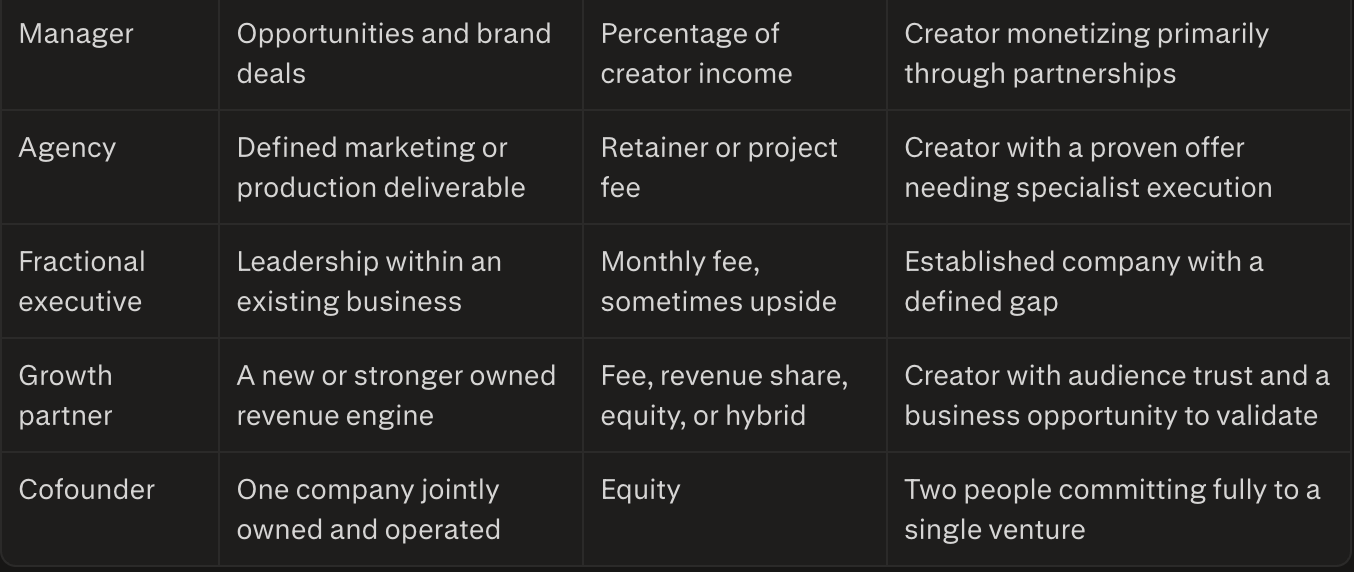
With my company, Dauntless, we cover the last two: growth partner and/or technical co-founder.
Who we work with
We work with creators, solo founders, and business owners who have:
A defined audience with meaningful trust or demonstrated demand
Reached a point where they want more options, not just brand deals
Expertise, access, story, or distribution that creates defensibility
Willingness to build real IP, not just increase followers
A meaningful problem worth solving repeatedly
Openness to measurement, iteration, and a longer partnership horizon
A growth partner is not for people who want:
Viral growth and vanity metrics
Brand deal management
A done-for-you “passive income” course
How an engagement works
We get right to the point. You fill out a short form so we can skip to high-level stuff, book a call, and start turning things around.
On that first call, we have a conversation to make sure we are crystal clear on your goals, brand, current setup, pain points, and timeline.
After that, we will put together a custom roadmap that gets you on track for more freedom, profit, and/or opportunities. You review the roadmap and give it your seal of approval.
Next, we make things official with a partnership agreement and get to work.
Finally, we do the set-and-forget stuff: set up recurring meetings, get on Slack/Signal/WhatsApp, and see the growth engine running (and maybe mute Stripe notifications; they get annoying after a while).
FAQs
-
It depends on the scope, contribution, risk, and maturity of the opportunity. Some engagements are fee-based, while others use revenue share, equity, or a hybrid structure that combines a base fee with performance-based upside. There is no standard percentage. Terms should reflect who contributes capital, execution, IP, distribution, and ongoing operational responsibility.
-
Your audience may be ready when you have earned trust around a clear problem, topic, skill, or transformation—and people consistently ask for deeper help, tools, recommendations, or access. Look for repeated questions, engaged replies, email-list growth, inbound demand, and signs that people already spend money to solve the problem. Followers alone are not enough
-
Creators can build businesses around digital products, apps, platforms, paid communities, memberships, courses, workshops, coaching, consulting, events, newsletters, software, licensing, media properties, physical products, or creator-led brands. The right model depends on the audience’s needs, the creator’s credibility, delivery capacity, buying behavior, and whether the offer can create meaningful outcomes beyond content consumption.
-
Start by defining ownership in writing before work begins. Agreements should clearly address brand assets, content, product IP, domain names, social accounts, email lists, customer data, payment accounts, access permissions, and what happens if the partnership ends. Keep key accounts under creator-controlled ownership where appropriate, limit access by role, and consult qualified legal counsel for your specific structure.
-
Ask what revenue is included, how revenue is calculated, what costs are deducted, how attribution works, and how often reporting and payments occur. Clarify responsibilities, decision rights, exclusivity, ownership of IP and customer data, duration, termination rights, and post-termination commissions. You should also ask what each party is contributing, what success metrics apply, and what happens if assumptions change.